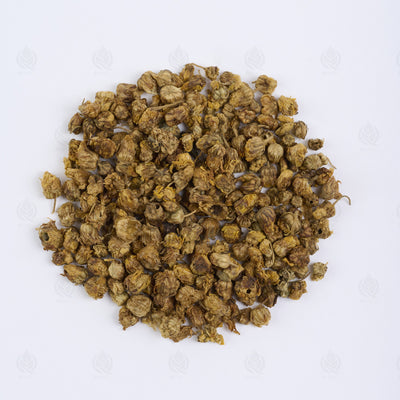
Drop a handful of dried flowers into the bottom of a bowl, pour on the hot water: slowly the petals unfold, the water takes on a pale amber and a scent of honey and hay rises in the steam.
The chrysanthemum — 菊花 (jú huā) — is one of those flowers that are drunk as much as they are gazed upon, and its presence runs through the whole of Chinese culture, from the scholar’s garden to the counter of the summer teas.
Portrait of a flower
A member of the vast Asteraceae family, cousin to the daisy and the sunflower, the chrysanthemum has been cultivated in China for close on three thousand years.
The patience of gardeners has drawn from it hundreds of forms, from the wildest to the most opulent, across a whole range of whites, yellows and golds.
For the cup, the flower heads are gathered before they are fully open, then dried with care.
Depending on the terroir, the flower is small and golden or broad and pearly: the white chrysanthemum of Hangzhou and the “tribute” chrysanthemum of the Huangshan mountains have long counted among its most celebrated ambassadors.
Human selection has done the rest: pompon flowers, tight balls, fine drooping needles or broad, plain daisies.
Few ornamental plants have inspired, in China and then throughout the Far East, such a collector’s passion, with its autumn exhibitions and its variety competitions.
The flower of the poets
Few flowers carry so much meaning. The chrysanthemum is one of the “Four Gentlemen” (四君子 Sì Jūn Zǐ) of Chinese painting, alongside the plum, the orchid and the bamboo — four plants raised into moral figures.
A flower that opens when the others fade, on the threshold of the cold, it has become the emblem of constancy, of long life and of the scholar withdrawn from the world.
The poet Tao Yuanming, in the fifth century, sang of it in lines that every Chinese schoolchild still knows: “Picking chrysanthemums by the eastern hedge, at ease I catch sight of the southern mountain.”
At the Double Ninth Festival, in autumn, the heights are climbed and toasts are drunk in chrysanthemum wine: the flower there crowns the year.
Since then the ninth lunar month has remained, for the lettered, “the month of the chrysanthemum”; it was admired in company, brush or cup in hand, and many painters have taken it up again and again, ink after ink, as an exercise in style as much as in fidelity.
From autumn to the summer bowl
Here is the charming paradox of this flower: queen of autumn in the garden and in the poems, it nonetheless reigns over the summer tables once dried.
Chrysanthemum tea — often married to a few red berries — is one of the most emblematic drinks of the hot season: clear, floral, barely sweet, of a handsome golden straw colour.
It is served warm or cool, on its own or at the end of a meal, in the great tradition of the fragrant infusions of southern China.
To drink chrysanthemum in summer is to call up a little of the coolness and the elegance that have always been attributed to this flower.
It is prepared without ceremony: a few flower heads in the bottom of a glass teapot, water trembling but not boiling so as not to hurry the petals, and one watches the flower come back to life in the water before touching one’s lips to it.
Some add a shard of rock sugar or a few red berries, for a play of gold and ruby that delights the eye as much as the palate.
Worth discovering
BotaQi gives pride of place to three faces of the chrysanthemum. Chrysanthemum buds - 菊花 (Ju Hua) offer the classic cup, tender and fragrant.
Wild chrysanthemum buds - 野菊花 (Ye Ju Hua), smaller and livelier, give its rustic and forthright version.
Lastly Chrysanthemum buds (large) - 胎菊花 (Tai Ju Hua), with the most generous flower heads, unfold an ample and luminous infusion — three ways of bringing summer into flower in the bowl.
Soon the flower will find its true season again: when the Beginning of Autumn comes, the chrysanthemum will pass from the summer bowl to the garden as it takes colour — and the year will turn, gently, towards Metal.