On 23 July the sun crosses the degree of 大暑 (Dàshǔ), the “Major Heat”.
It is the peak of summer, but a peak weighed down with damp: the air clings to the skin like a warm cloth, the storms break at the end of the afternoon, and the earth itself seems to breathe out the heat it has patiently stored.
Nothing stirs in the full hours; everything waits for the evening.
This is the hour when the nap is no longer a luxury but an obvious course, when one watches for the first breath of air at dusk as for a deliverance.
The peak of summer
After the Minor Heat comes the Major: Chinese nomenclature, faithful to its taste for degrees, reserves for this breath the thermal summit of the year.
The old almanacs noted here the abundant rains, the moisture of the paddy fields, the brazen thriving of the wild grasses and the heavy flight of the fireflies at dusk.
It is the fortnight in which nature gives everything, in which the fruits ripen in a single surge and in which one watches, between two downpours, for the least breeze off the river.
Major Heat: the name rings like an apogee — and, like every apogee, it already announces the turn.
The old almanacs divided this breath into three pentads of striking poetry: “the grass that decays turns into fireflies”, “the ground is sodden, the air moist and heavy”, and finally “the great rains fall at intervals”. Three images to say summer at its height, already brimming with water.
When Fire tips towards Earth
The 23rd of July marks a discreet pivot in the wheel of the five phases.
The blazing summer of Fire gives way to a season the Chinese tradition calls 长夏 (cháng xià), the “long end of summer” — that of the Earth Phase.
Between the ardour that begins to fade and an autumn still far off opens a moist, ripening in-between, with no real equivalent in our Western calendar.
Classical thought made of it a season in its own right, a hinge and a giver of plenty, placed at the centre of the four others as the earth stands at the centre of the field.
This tipping is in no way abrupt: it is guessed at rather, through a thousand signs — a new heaviness in the air, a smell of rain on warm dust, the morning mists laid over the paddy fields.
Summer does not go out; it thickens and settles.
Earth, the season of damp
With this Earth Phase the tradition symbolically associates the colour yellow, the sweet flavour, the idea of centre and of ripening — and, climate obliging, damp (湿, shī).
It is the season of granaries filling, of gourds rounding out, of patient soups set at the edge of the fire. In this grammar of correspondences, Earth is also linked, symbolically, to the Spleen: here again, what must be read is a language of poetic resonance and not an instruction leaflet.
The long end of summer thus invites a return to the centre — after the exuberance of Fire, one comes back towards the middle, towards what sustains, towards the slowness of gentle cooking and the wisdom of things that ripen without haste.
It is also the season of overflowing markets, of stalls of gourds and melons, of granaries watched against mould: everywhere, Earth recalls that it is the great lap from which all comes and to which all returns.
Worth discovering
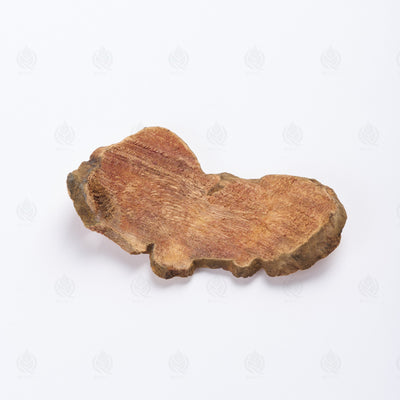
To the moist table of the Major Heat, southern China replies with its long-simmered soups. Chinese sarsaparilla - 土茯苓 (Tu Fu Ling) — whose very name opens on the character 土 (tǔ), “earth” — is a root emblematic of those Lingnan broths, one that classical dietetics places among the sweet and bland flavours. In the kitchens of the south it is simmered for hours with a little meat or duck, until a broth of clouded sweetness, emblem of the late-season table.
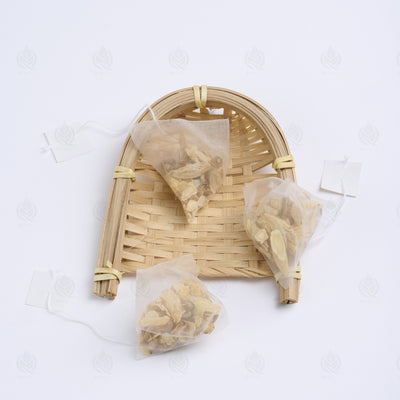
The Four Treasures Infusion - 四宝茶 (Si Bao Cha), a spare and fragrant assembly, is a handsome companion to this tipping towards Earth — two ways of entering the long end of summer.
The Major Heat will soon close summer: in early August the breath of 立秋 (Lìqiū), “Beginning of Autumn”, will sketch the very first withdrawal of the year.