In the muggy streets of southern China, in Canton as in Hong Kong, a stall is recognised from afar by its great copper jars and by the slate on which plant names are lined up.
There one drinks standing, often in one go, a bowl of dark and fragrant infusion: this is 凉茶 (liáng chá), “cool tea”, one of the most everyday gestures of the southern summer.
A few coins are handed over, the bowl is set down, off one goes: nothing more ordinary, and yet a whole stretch of southern culture is held in that quick gesture.
An institution of the South
The country of Lingnan — those hot, humid southern provinces backing onto the tropics — has made the refreshing infusion into an institution.
For centuries, long decoctions of plants, barks and flowers have been composed there, simmered for hours in great cauldrons, then kept cool in brass urns.
The 凉茶铺 (liángchá pù), those cool-tea shops, punctuate the pavements as cafés punctuate the squares elsewhere; certain signs, such as the venerable Wang Laoji born in the nineteenth century, have become household names across a whole region.
To drink a liáng chá is to take part in an urban and popular culture, handed on from counter to counter and from generation to generation.
In these provinces where the air, in summer, grows as thick as a damp cloth, fragrant coolness has become an art of living in its own right — on the same footing as the famous “slow-fire soups” (老火汤) simmered for hours, or as the morning tea taken with the family at the restaurant.
Drinking, in the South, is never a merely useful gesture: it is a way of inhabiting the climate.
Drinking cool, drinking fragrant
Behind that single name lies a whole palette.
There are the frankly bitter brews, swallowed in one gulp with a wrinkled nose, and the gentler versions, floral, almost sweet, sipped at length in the shade.
What they share is not a fixed recipe but an art: that of serving cool and fragrant, at cellar temperature rather than icebox temperature, in keeping with the “gentle coolness” dear to the Chinese summer.
Every family, every stall keeps its own proportions, its own knack, its own favourite flower — and a good liang cha is known by its scent as much as by its handsome bitterness.
Some houses slip in a flower, a strip of citrus peel, a shard of rock sugar; others will not budge from an uncompromising bitterness. There are as many styles as there are neighbourhoods and dialects.
An everyday gesture of summer
Through the hot months, the refreshing infusion paces the day: a bowl on the way out of the market, another at the afternoon pause, a last one at dusk when the city breathes again at last.
It is drunk alone at the counter or by whole teapots, set at the centre of the family table, each helping themselves at leisure from small bowls.
It is a way of living summer in small mouthfuls, a way of keeping company with the hot season far more than of resisting it — a liquid hospitality, offered to whoever comes through the door.
In many families a large jar stands permanently on the sideboard, and is drawn from morning to night; elsewhere it is the Sunday ritual, when the household gathers around a single teapot.
Liang cha is passed on in this way like a family recipe, with its jealously guarded variants and its scents that call back, for each person, a childhood and a city.
Worth discovering
The repertoire of summer infusions is easily assembled at home.
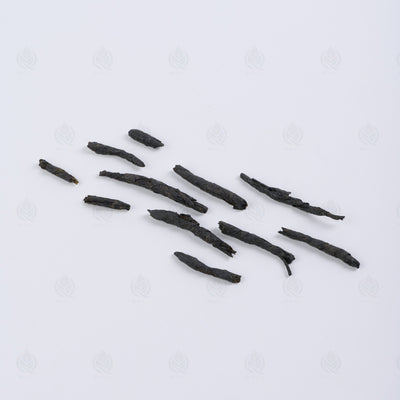
Bitter tea (Bitter holly) - 苦丁茶 (Ku Ding Cha) embodies its most forthright face, long and lively in the mouth.
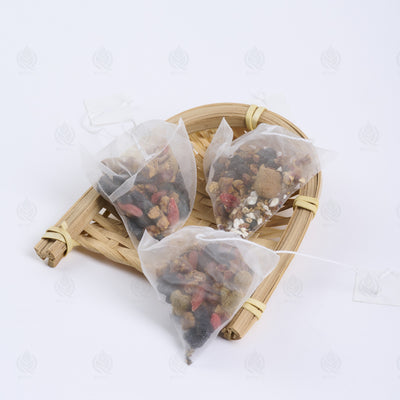
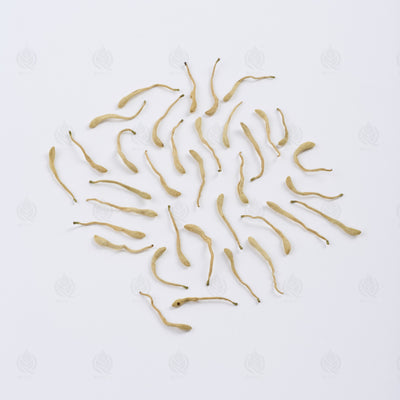
The Eight Treasures Infusion - 八宝茶 (Ba Bao Cha) offers its most convivial and fragrant version, while Japanese honeysuckle - 金银花 (Jin Yin Hua) and Chrysanthemum buds - 菊花 (Ju Hua) bring their floral notes, clear and golden — four ways of composing one’s own cool-tea culture.
These cool mouthfuls will accompany the rise of the heat right to its peak: on 23 July, the Major Heat will open the long end of summer, season of the Earth.