There is, at the heart of the Chinese summer, a period the calendar names the 伏 (fú) days — literally “to lie low”, as one takes to the shade when the sun beats down.
These are the heaviest days of the year, the ones when the blinds come down and when there rises, sometimes, in a courtyard or a shop, the acrid, green smell of mugwort slowly burning.
The three ten-day spells of high heat
The 三伏 (Sān Fú) name three periods spread from mid-July to mid-August: 初伏, the first fu, 中伏, the middle fu, and 末伏, the last fu.
Their dates are reckoned on the celestial stems of the ancient sexagenary calendar, which makes them shift a little each year. The character 伏 says it all: through these days, men and beasts lie low, seek the shade, slacken their pace.
A popular saying even settles the table for this fortnight — “at the first fu, dumplings; at the second, noodles; at the third, egg pancakes”. The high heat, here, is not merely endured: it is named, ordered, written into the almanac.
It was expected, prepared for; the work of the fields and the rhythm of the household were adjusted to its coming.
Moxibustion, a gesture of summer
With these burning days the tradition has long associated moxibustion — 艾灸 (ài jiǔ), the art of making dried mugwort glow slowly a short way from the skin.
The character 灸 is eloquent in itself: it lays fire (火) over the idea of duration (久), as though to name a heat that takes its time. The plant is rolled into small cones or into compact sticks, it is lit, and a diffuse warmth, carried on a scent of smoked hay, spreads through the room.
Practised on the fú days, it takes the fine name of 三伏灸 (sān fú jiǔ), the “moxibustion of the three fu”.
Mugwort, for that matter, inhabits the whole Chinese calendar: bunches of it are hung at doorways for the Dragon Boat Festival.
Around the person lying there, time seems to hold: one watches the small ember, moves it, revives it, and the whole attention gathers on the gesture itself.
A patient, almost meditative gesture, moxibustion belongs to the heritage of the Chinese arts on the same footing as calligraphy or the tea ceremony — its use is very old, attested as early as the silk manuscripts unearthed from the Mawangdui tombs, more than two thousand years old.
“Preparing for winter during the summer”
Why summer? An adage sums up this seasonal wisdom, which the tradition renders as “preparing for winter during the summer”.
The idea is thoroughly philosophical. Since summer is the hottest season, the most yang, the one most turned towards the outside, Chinese culture sees in it the right moment to bring one’s gestures into accord with the great wheel of the year — to cultivate in full light the accord one wishes to hold right into the cold season.
Far from being a recipe, it is a way of thinking time as a cycle, in which each season quietly prepares the next and in which nothing, ever, is lived in isolation.
It is the same intuition that has the hay brought in during July or the fruit dried at the height of the sun: the fine season works for the harsh one, and the whole year is thought of as a single piece.
Worth discovering
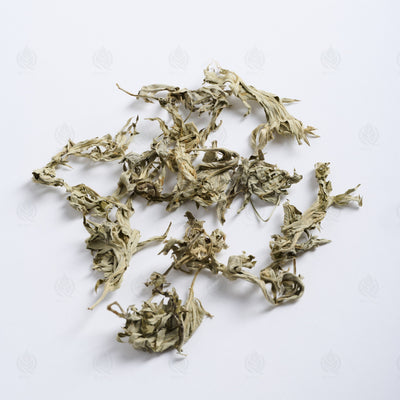
At the heart of this ritual, a single plant: Chinese mugwort (艾叶 Ai Ye), whose leaves are dried.
The word 针灸 in fact brings together the needle (针) and the fire of mugwort (灸) in one and the same expression, so closely have the two gestures travelled together down the centuries.
It is its silvered leaves, velvety on the underside, that are found hanging at doorways for the Dragon Boat Festival: the same plant keeps watch over the threshold of the house and over the fú days.
The fú days will soon give way to the Major Heat: the peak of summer, moist this time, in which the long season of Earth already opens.